
As Anthony Bourdain once said, “A cook only needs a good chef’s knife”. It’s a simple truth which highlights the importance of a blade that can almost do it all. Such a tool can slice, chop, dice, mince, and crush virtually any ingredient with precision and ease. This makes it a reliable ally in the kitchen.
In the culinary world, there’s a variety of chefs knife styles that get the job done. Things get tricky when choosing that one blade, so it helps to know your options.
Classic Chef’s Knife (Western Style)
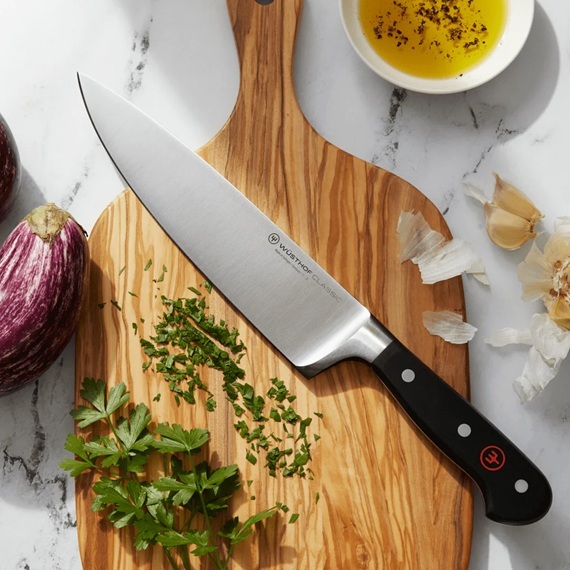
First on the list is the classic chef’s knife. This is the most versatile Western knife, an all-rounder that can handle almost any task in the kitchen.
What can it do? Pretty much everything. Slice meat, chop veg, dice onions, mince herbs, crush garlic. It’s your go-to for everyday prep, the real workhorse of the kitchen.
Originally from Europe, Western knives are usually made by German, French, and American manufacturers, in contrast to Eastern versions originating from Japan and are known for their thinner, more precise blades.
Western-style blades are balanced, comfortable, and made to feel like an extension of your hand. They usually feature a broad blade, around 20 cm long, with a gentle curve that lets you rock the knife smoothly as you chop. The tip is sharp and slightly pointed for precision work, while the wider heel gives you power for tougher cuts.
When it comes to how they’re made, Western styles can range from partially or completely handmade to partially or completely factory-produced. This depends on the manufacturer itself. Some are traditionally forged while others are mass-produced.
Material-wise, most blades are made from stainless steel or high-carbon steel. Stainless is low-maintenance and resists rust. High-carbon holds a sharper edge but needs a little more care. Handles can vary, too. Wood gives a classic look, but synthetic materials offer better durability and grip.
Popular brands like Wüsthof, Zwilling, Victorinox, and Global all make versions of this classic. If you’re still unsure, these brands are a safe starting point because they’re all trusted for their craftsmanship and reputation in the kitchen.
Santoku Knife
Next up is the Santoku knife. This Japanese-style kitchen blade is a great alternative to the classic Western chef’s knife. The name “Santoku” means “three virtues” or “three uses”, which refers to its ability to slice, dice and chop. It’s the perfect example of a versatile ally in the kitchen.
Design-wise, the Santoku has a shorter and flatter blade (around 16 to 18 cm) compared to Western styles, with very little curve. This flat edge makes it ideal for a straight up-and-down cutting motion rather than a rocking style. This gives you clean, precise cuts with minimal effort.
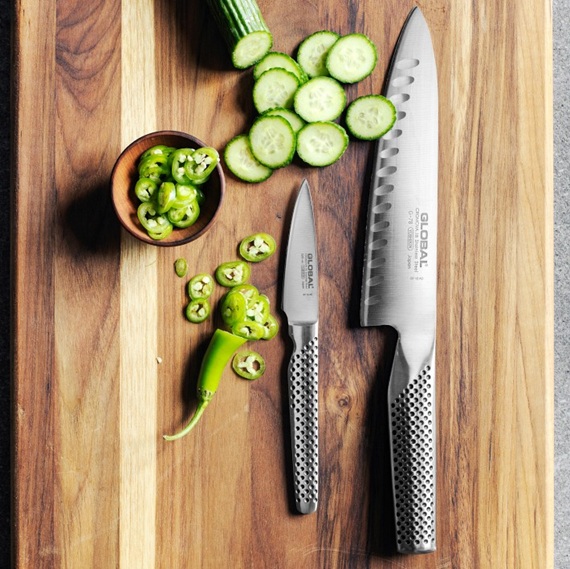
The blade is thinner and lighter, so it’s easy to handle during everyday prep work. Santoku knives are usually made in Japan, where precision and sharpness are key design priorities. They often use high-carbon stainless steel, which helps maintain a sharp edge while still offering reasonable rust resistance. Some traditional versions may feature a Granton edge. A Granton edge is the row of dimples or scalloped grooves found on the sides of the blade.
These indentations create small air pockets between the blade and the food, helping reduce food sticking as you slice.
Handles can vary by brand, but you’ll often see a simple, ergonomic design that keeps the focus on balance and control. Popular brands like Global, Shun, and Miyabi all offer versions of this knife, making it a strong choice for anyone looking to expand beyond the classic chef’s knife.
Gyuto
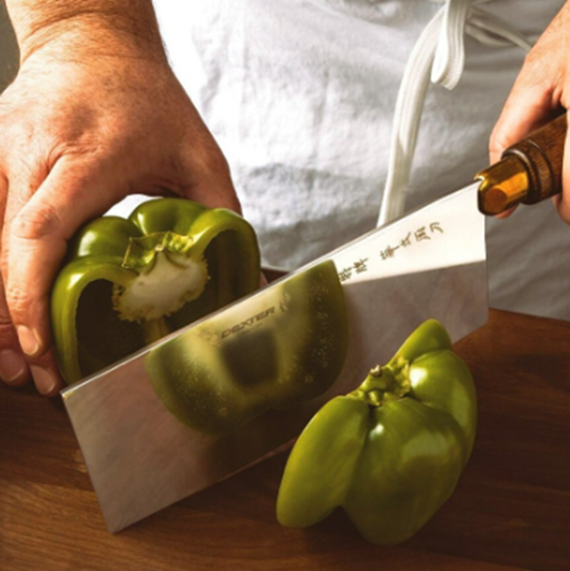
Another one on the list is the Gyuto. A popular Japanese version of the classic Western chef’s knife, this blade can do a wide range of tasks and be used with a variety of different cutting techniques. Although it closely resembles a Western chef’s knife, it has a lighter, more refined Japanese design.
The Gyuto features a long, narrow blade (somewhere between 18 and 24 cm) with a gently curved edge that allows for smooth rocking and slicing motions. The blade is thinner than most Western versions, which gives the knife a more agile and precise appearance.
The tip is usually sharp and slightly pointed, making it ideal for detailed cutting work, while the spine tapers gently toward the front for a balanced, elegant profile. Many Gyuto knives have a subtle bevel and a polished finish, ranging from clean stainless steel to a more traditional hammered or matte texture.
Handles can also vary in style. Some feature a simple, lightweight Japanese wa-handle (often octagonal or oval), while others use a Western-style handle for a more familiar grip.
Last but not least, no matter which ally you choose in the kitchen, make sure to care for it properly. Regularly sharpen, hone, and properly store your kitchen knife to preserve its longevity and performance.