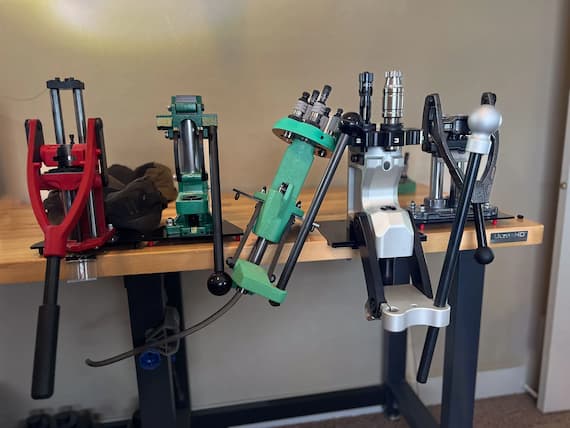

As the specialized mechanical devices, reloading presses are made for easy assembling of components like bullets, primers, cartridge cases and powder alike into the cartridges you’re going to use in firearms. Whether it’s the bulk shooting savings or the accuracy improvement with the customization of powder loads, there are various reasons why hunters, target shooters and gun owners make use of them.
Shooting volume, goals, budget – these are some of the crucial factors that are at play when it comes to choosing a reloading press type suitable for your needs. Round count and experience level are two additional considerations you can’t afford to overlook – more so if this is the first press you’re buying. To simplify the shopping process for you, here’s some basic info on the types you can choose from.
The Reloading Press Types
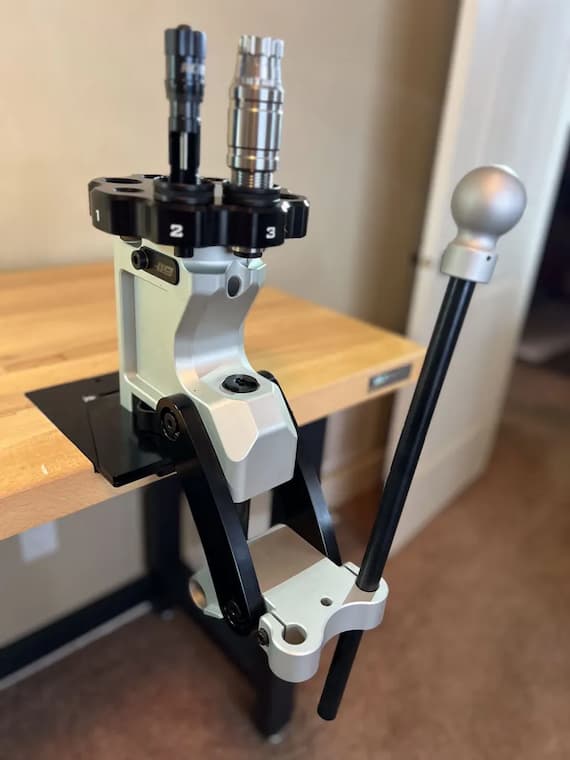
Single-stage
This is the press designed to process one die at a time, which sums up to about 50 rounds per hour. As such, it’s the best option for control and accuracy if you don’t mind the time spent on the process. This makes it one of the most suitable choices for beginners who are still learning and are after rifle load development with precision, instead of needing a large quantity of ammunition.
It’s primarily used for ammunition rifles and handguns, finding its way in long-range hunting and shooting. Some of the common uses include the .308 Winchester, .30-06 Springfield and 6.5 Creedmoor. It’s also one of the most affordable options in the market, perfect if you’re starting out with a tight budget. There are two types you can shop from:
“O” frame – This traditional option is great if you need a press with fewer chances for deflection. The downside is it’s more rigid and not that accessible when it comes to the workspace.
“C” frame – For more accessibility to the workspace, pick out this alternative. Though, keep in mind, it’s more susceptible to deflection. Invest in a more advanced option to avoid this issue.
Turret
If you’re looking for the best of what both the single-stage and progressive types can offer, then you should be after the turret press. With accuracy and a loading rate of about 150 to 250 rounds per hour, this is an alternative upgrade to the single-stage.
It’s created with the added benefit of giving the reloader the chance to rotate or index the turret head to the new station and die setup without the need to screw or unscrew the individual dies. It’s another affordable option, however it’s one that offers more speed so it comes with a slightly higher price than the single-stage. It’s great for loading pistols and rifles.
Progressive
If high-volume reloading is what you’re after, then look no further than the progressive reloading press for sale. Keep in mind it’s more complex than the previous two choices as there’s more of a learning process to understand the mechanics and safety requirements. It also comes with a high price tag, but it’s a great investment overall for those training and competing, using something like AR in .223.
If you get to do a lot of shooting and are tight on time, this is it. And, to give you an idea compared to the single-stage and turret, standard progressive presses produce around 400 to 600 rounds per hour. Ultra-high-volume setups go as up as 800 to more than 1000 per hour.
What Are the Top Brands of Reloading Presses?
While the market is abundant, and you have plenty to choose from, some trusted names many swear by include RCBS, Hornady, Forster, Dillon Precision, Lee, and Redding.
In terms of single-stage, you have some solid options, such as:
- RCBS Rock Chucker Supreme – For long-lasting durability, precision and versatility that can handle from small cartridges to large cases, this is one of the best presses you can swear by. Although it’s truly built to last, this brand offers great support with reliable warranty.
- Forster Co-Ax – With the floating S-jaw for low runout, and snap-in die design for easy changing of the dies by hand, it’s a press made for superior alignment. While it’s not suitable for high-volume pistols, it’s still an exceptional choice for instant die changes, with high mechanical advantage coming from the compound linkage fit for simplifying heavy tasks.
- Lee Classic Cast – With a rigid “O” frame, made from cast iron for incredible strength, great value price (lower than the Rock Chucker), clean hollow-ram primer disposal, and fast die swaps thanks to breech lock bushing, it’s yet another considerable press model you should keep in mind.
For turret, you have the standout:
- Redding T-7 – If budget isn’t an issue, and you’re willing to go more in terms of design than the Lee Classic Turret choice, this is the premium one you can buy. It’s premium considering it’s got cast iron rigidity, the precision of a single-stage, and the convenience to keep multiple dies mounted and indexed thanks to the seven staged stations feature.
When it comes to progressive presses, there are two popular choices you can choose:
- Hornady Lock-N-Load AP – The high production, the fast die changes, the auto-indexing with a case-activated powder drop for automatic operation and adjustment-free cartridge ejection, plus the great pricing are just some of the reasons behind this press’s popularity.
- Dillon RL550C – For unmatched versatility with different cartridges, high output, manual indexing easy to troubleshoot and total individual control over the rounds, this is a classic choice.